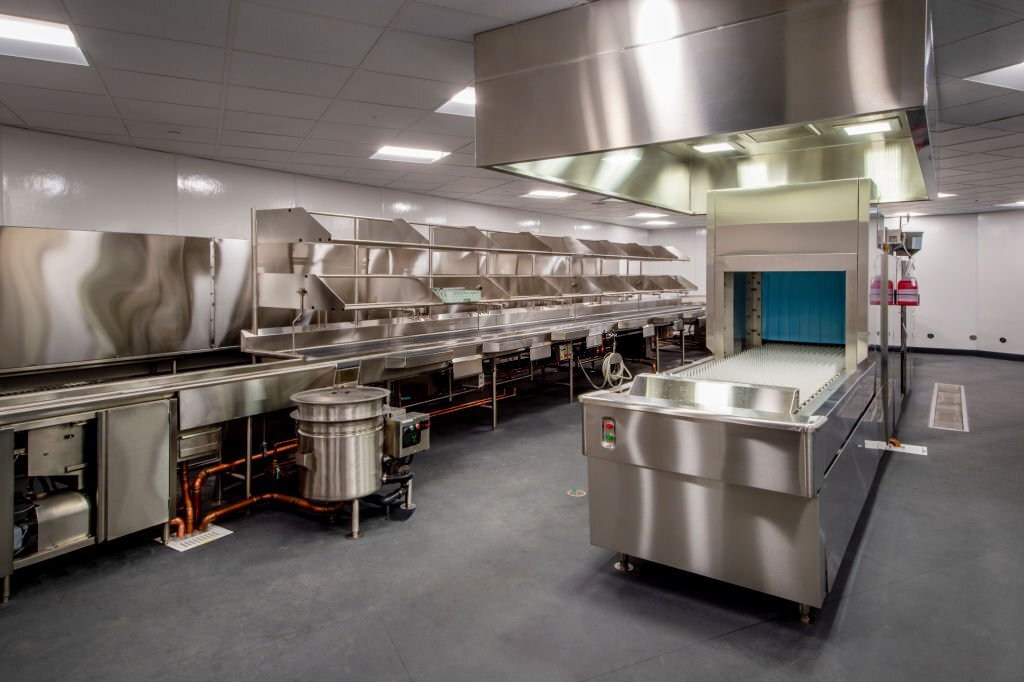
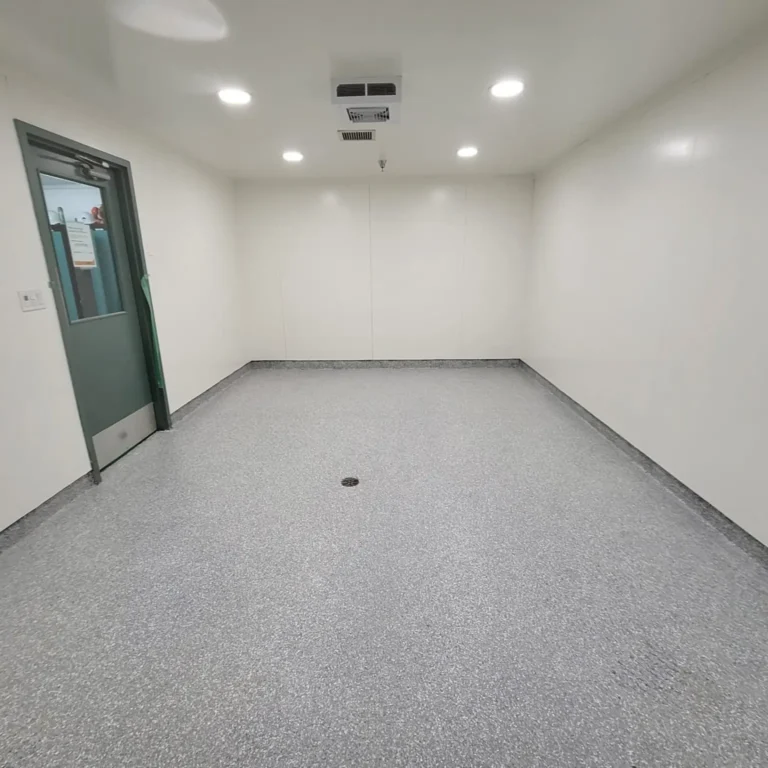
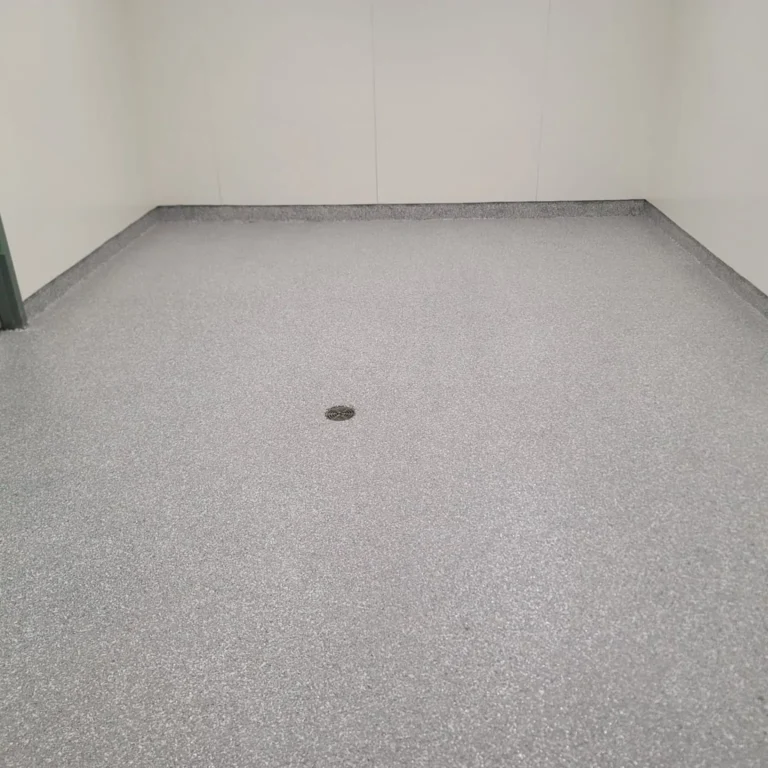
Commercial kitchen with stainless-steel equipment and a seamless grey floor

Metro Vancouver commercial kitchen flooring

Commercial Kitchen Epoxy Flooring Vancouver, BC

Seamless resin flooring specified for the conditions in each cook line, dish pit, prep area, cooler entrance and service corridor—not one coating forced across every zone.

Priority One installs commercial kitchen flooring in Vancouver and the Lower Mainland. We assess heat, hot-water cleaning, grease, chemicals, moisture, traffic, drains, concrete condition and closure time before recommending PU-cement, epoxy quartz or another suitable floor build.

  • PU-cement / urethane cement
  • Quartz-broadcast epoxy
  • Integral resin cove base
  • Drain and transition detailing

Start with the operating conditions

A Commercial Kitchen Floor Is a System of Zones

The cook line, dishwashing area and dry-store corridor may sit metres apart, but they do not impose the same demands on a floor. Heat, grease, hot wash water, sanitizers, refrigeration, rolling loads and standing moisture vary by zone. The most durable scope is therefore based on what happens in each area and what is underneath it.

For demanding hot and wet areas, a polyurethane-cement system—also called PU-cement, urethane cement or cementitious urethane—is often the leading candidate. In lower-thermal-load prep and support spaces, a quartz-broadcast epoxy may be appropriate. Neither choice should be made from a product label alone: slab moisture, contamination, repairs, drainage, joints, texture and return-to-service requirements can change the correct specification.

Zone-by-zone specification

Commercial Kitchen Flooring Systems by Work Area

This matrix is a starting point. Final products, build, thickness and texture are confirmed after the existing assembly and operating conditions are reviewed.

Kitchen zone Typical exposure Likely starting point Details to resolve
Cook lines and fry stations Heat, hot oil, grease, impact and aggressive cleaning PU-cement / urethane cement Temperature exposure, equipment legs, edges, texture and shutdown
Dish pits and pot wash Frequent water, detergents, steam, carts and drain traffic Textured PU-cement Drain condition, ponding, cove base and cleaning method
Prep kitchens and bakery support Food debris, carts, moderate washdown and localized heat PU-cement or epoxy quartz Actual wash temperature, cleaners, oils and impact
Coolers and freezer thresholds Low temperature, condensation and thermal transition Condition-specific resin build Operating temperature, defrosting, substrate and installation temperature
Dry storage and service corridors Carts, rolling loads, abrasion and spills High-build epoxy or quartz broadcast Traffic, UV exposure, transitions and desired finish
Existing tile, plywood or patched areas Movement, hidden moisture, weak bond lines and mixed materials Investigate before specifying Removal, substrate replacement, waterproofing and structural movement

Failure analysis

Why Kitchen Floors Fail at the Details

A thick product cannot compensate for a contaminated slab, moving substrate, failed plumbing or an unsuitable transition. The investigation matters as much as the coating chemistry.

Contamination and weak concrete

Grease, oil, old adhesive, laitance and deteriorated concrete can interfere with bond. Mechanical preparation and repairs must reach a sound, clean substrate.

Moisture and thermal cycling

Moisture-vapour pressure and repeated hot-to-cold changes can stress a floor. Testing, system selection and manufacturer limits need to match the actual exposure.

Drains, joints and terminations

Drain rims, trench edges, door thresholds, wall junctions and construction joints are common entry and impact points. They require deliberate detailing—not a thin pass of coating.

Standing water and poor fall

Resin follows the substrate. Local mortar correction may improve minor depressions, but major drainage defects can require demolition, new screeds or design by other trades.

Movement below the finish

Loose tile, unstable plywood, flexing assemblies and active cracks can transfer movement into a rigid finish. The substrate must be made suitable before coating.

The wrong traction profile

Too smooth can be hazardous when contaminated; unnecessarily coarse texture can trap soil and slow cleaning. The finish needs to balance traction with the sanitation method.

Choose chemistry for the exposure

PU-Cement vs. Epoxy Quartz for Commercial Kitchens

Moderate-duty and support zones

Quartz-Broadcast Epoxy

A multi-layer epoxy system reinforced with broadcast aggregate. It creates a seamless, textured and cleanable finish and can be a good fit where thermal shock and continuous hot washdown are not the controlling risks.

  • Potential fit for prep, dry storage and service corridors
  • Texture, colour and build can be adjusted to the room
  • Requires sound preparation and compatible substrate moisture conditions
  • Not automatically interchangeable with a PU-cement kitchen system

The perimeter is part of the floor

Cove Base, Drains, Slope, Joints and Transitions

Open floor area is usually the easy part. A reliable scope maps every place where water, impact or movement can reach an edge.

Integral cove base

A resin cove creates a curved, cleanable transition at selected wall-to-floor junctions. Cove height, wall condition, termination and equipment plinths must be included in the measured scope.

Drains and trenches

Existing drain bodies, rims, trenches and surrounding concrete are inspected for movement, corrosion, damage and usable termination geometry before the floor detail is chosen.

Slope and ponding

Local low spots may be repairable. Widespread incorrect fall can exceed a coating contractor's scope and require a new sloped assembly or coordination with plumbing and concrete trades.

Cracks and joints

Cracks are assessed, and existing moving joints are honoured or treated according to the design. No resin system can promise that future structural movement will never telegraph through.

Thresholds and cool-room entries

Elevation, door clearance, thermal transition, cart impact and neighbouring flooring all affect the termination detail and whether a ramp or metal edge is required.

Penetrations and equipment

Posts, curbs, legs, conduits and fixed equipment create extra edges. The quote should state what is moved, protected, coated around or excluded.

A necessary limitation

A Resin Floor Is Not an Automatic Waterproofing or Drainage Repair

A seamless surface can reduce joints in the traffic layer, but it does not by itself correct leaking plumbing, failed drain connections, widespread negative slope, structural movement or an unsuitable wood assembly. If water is migrating below the floor—or into a suite beneath—the source and complete assembly must be investigated before another coating is applied.

In some kitchens, the responsible recommendation may be selective demolition, plumbing repair, substrate replacement, a designed waterproofing membrane, a new sloped screed, tile or another assembly instead of resin. Identifying that before installation protects the operator from paying for a cosmetic fix over an unresolved building problem.

Traction is a system decision

Wet-Floor Traction Without Making Cleaning Impractical

No floor is “slip-proof.” Water, grease, footwear, housekeeping, drainage and texture all influence traction, so a blanket non-slip claim is not a useful specification.

What we assess

  • Whether contamination is water, grease, oil, food solids or chemicals
  • Pedestrian direction, carts, ramps, turns and drain approaches
  • Cleaning tools, frequency and ability to rinse and recover soil
  • Footwear policy and any owner-required test method or criterion

What the scope should state

  • Aggregate type and intended texture range
  • Whether different zones receive different profiles
  • Sample or mock-up expectations when appearance is important
  • Cleaning and maintenance guidance for the selected finish

Accurate health-approval language

What “Food-Safe” and Health Approval Actually Mean

There is no universal sticker that makes an entire installed kitchen floor automatically approved. In British Columbia, proposed construction or alterations to food premises may require plans and specifications to be reviewed by the applicable health authority. The facility operator—not the flooring contractor—obtains the operating approval or permit and confirms requirements with the environmental health officer.

Priority One can help assemble the flooring portion of that review: product data sheets, the proposed layer build, floor and cove details, finish information and cleaning guidance. The selected materials should be suitable for their intended purpose, durable and cleanable, while the completed floor must support the facility's sanitation procedures. Final acceptance remains with the authority having jurisdiction.

Prep first, then manage the reopening window

Our Commercial Kitchen Flooring Process

  1. 01

    Operational and site review

    We map zones, traffic, heat, washdown, chemicals, drainage, existing failures, access and the real closure window.

  2. 02

    Substrate investigation

    The current floor, concrete soundness, contamination, cracks, joints, moisture risk and edges are assessed before the build is finalized.

  3. 03

    Written scope and phasing plan

    The proposal identifies preparation, repairs, products, layers, coves, drains, texture, exclusions, cure conditions and handover timing.

  4. 04

    Mechanical preparation and repairs

    Existing incompatible material is removed as required, the substrate is mechanically prepared, and approved repairs and edge details are completed.

  5. 05

    System installation

    The approved primer, body coats, aggregate and seal coats are installed within the selected manufacturer's conditions and recoat windows.

  6. 06

    Inspection and handover

    Details are reviewed and the operator receives the confirmed foot-traffic, equipment, cleaning and chemical-exposure schedule.

Relevant local experience

Commercial Kitchen Project Evidence

These examples are intentionally unnamed and limited to known project conditions. They show how system selection changes when heat, moisture, drainage and the underlying assembly are considered.

Completed application · Vancouver

Bakery proofer / oven zone

Approximate area
50 sq. ft.
System
Urethane cement
Reason for selection
Localized heat, moisture and sanitation demands

The system was confined to the harder-use proofer/oven zone. This is the same specification principle used on larger kitchens: match the build to the exposure instead of overselling one finish for every room.

Assessment lesson · Burnaby

Institutional dishwashing area

Observed condition
Standing water and poor fall to drain
Reported risk
Water migration / leakage below
Key conclusion
Coating alone could not resolve the complete assembly

This assessment illustrates why the drainage path and underlying assembly must be addressed before specifying a finish. Sometimes the most valuable flooring advice is identifying work that must happen first.

Build a comparable quote

What Affects Commercial Kitchen Flooring Cost?

A useful price separates preparation and detailing from open-floor square footage. Small kitchens can carry a higher unit cost because mobilization, edges, drains and coves remain labour-intensive.

Cost drivers

  • Removal of tile, paint, failed resin or adhesive
  • Grease contamination and concrete deterioration
  • Crack, patch, drain-edge and threshold repairs
  • System chemistry, thickness and number of layers
  • Linear footage and height of integral cove
  • Equipment movement, access and night work

Send with your quote request

  • Address, floor plan and approximate square footage
  • Current floor and known leak or moisture history
  • Wide photos plus close-ups of drains and failures
  • Cleaning chemicals and maximum wash-water temperature
  • Required cove height and number of drains
  • Last service, reopening and equipment-load times

Food-service and institutional work

Facilities We Serve Across Metro Vancouver

  • Restaurants and quick-service kitchens
  • Commissaries and shared kitchens
  • Hotels and banquet kitchens
  • Bakeries and production kitchens
  • Schools, campuses and recreation facilities
  • Healthcare and care-facility kitchens
  • Food-court and grocery preparation areas
  • Food and beverage production support zones

Priority One is based in Richmond and reviews commercial kitchen flooring projects in Vancouver, Richmond, Burnaby, Surrey, Delta, New Westminster, Coquitlam, North Vancouver, West Vancouver and other Lower Mainland communities. Larger British Columbia projects can be reviewed by scope.

Answers before you request a quote

Commercial Kitchen Epoxy Flooring FAQ

What is the best flooring for a hot, wet commercial kitchen?

PU-cement is often the leading candidate for cook lines, dish pits and other areas exposed to hot water, thermal cycling, grease and aggressive cleaning. The final choice still depends on the product's performance data, thickness, substrate, chemicals, temperature and maintenance routine.

Can epoxy flooring be used in a commercial kitchen?

Yes, in the right zone and build. A quartz-broadcast epoxy may suit moderate-duty prep, storage or corridor areas. A conventional thin epoxy is not automatically suitable for hot washdown or thermal-shock exposure, where PU-cement may be more appropriate.

Can you install resin flooring over existing tile?

Sometimes, but only after the tile, grout, bond, elevations, contamination and moisture path are assessed. Loose or unsuitable tile should be removed. Coating over a failing assembly simply transfers its weakness into the new floor.

Can epoxy or PU-cement be installed over plywood?

Wood assemblies require special caution because they move and can conceal moisture or plumbing problems. The substrate may need replacement or a designed assembly; resin should not be presented as a universal fix over wet or unstable plywood.

Will a new coating fix standing water and poor slope?

It can help with limited local correction when the design and available elevations allow. Major fall or drainage problems may require demolition, a new sloped screed, drain work or coordination with other trades before the finish is installed.

Is the finished floor non-slip?

No responsible contractor should call any floor slip-proof. Aggregate can increase wet-area traction, but safety also depends on contamination, drainage, cleaning, footwear and maintenance. We select a texture that balances traction with practical sanitation.

How long will the kitchen need to close?

It depends on removal, repairs, floor area, layers, temperature and the selected product's cure requirements. Some work can be phased or scheduled around a closure, but the approved written schedule should govern foot traffic, equipment loading, cleaning and chemical exposure.

Does the floor automatically pass Vancouver Coastal Health inspection?

No flooring contractor can guarantee approval of an entire food premises. Priority One can specify a durable, cleanable floor system and provide relevant product and detail information. The operator must confirm the project with the applicable environmental health officer, who determines final acceptance.

How much does commercial kitchen flooring cost in Vancouver?

Cost depends on removal, contamination, concrete repair, floor area, coves, drains, system build, access and the closure window. A site-specific, itemized proposal is more reliable than a universal per-square-foot price because the hardest details are not measured by open floor area alone.

Choose the page that matches the facility

This page covers back-of-house commercial kitchens. Use the broader restaurant page for dining, bar and front-of-house areas, and the food-processing page for production plants and larger processing environments.

Commercial kitchen flooring Vancouver, BC

Get the Floor Build in Writing Before You Compare Prices

Send the kitchen size, current floor, operating conditions, closure window and photos of the drains and failures. We will identify the preparation, system and detail questions that need to be resolved before pricing.