Epoxy vs Polyaspartic Garage Flooring — Which Is Best for Vancouver?
If you’re upgrading a garage or small parkade in Vancouver, you’ve probably heard about both epoxy and polyaspartic coatings. They’re often pitched as direct competitors, but in reality they solve slightly different problems.
This guide takes a Vancouver-first look at each system — how they handle moisture, UV, downtime and budget — so you can pick the right garage floor for your home, strata, or commercial space.
Why Vancouver’s climate changes the decision
Vancouver’s mild but wet climate means your garage floor has to deal with rain, grit, road salt and humidity almost year-round. Moisture in the concrete is a huge factor: if it isn’t tested and controlled, even the best coating can peel.
That’s why the first decision isn’t “epoxy vs polyaspartic” — it’s “has the slab been tested and properly prepared?” Once moisture and prep are handled, chemistry becomes the fine-tuning for cure time, UV stability and budget.
Epoxy vs polyaspartic at a glance
Ideal for most residential garages and many light commercial spaces where you can give the floor 1–3 days to cure.
- Excellent value on 1–2 car garages.
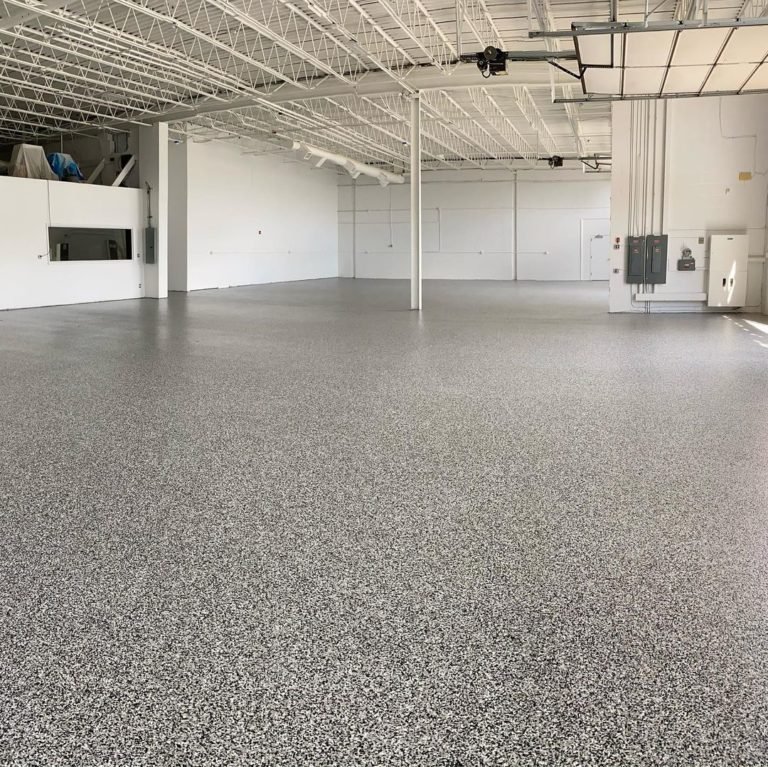
- Decorative flake, solid colour or metallic options.
- Very durable when installed at the right thickness.
- Needs a UV-stable topcoat for areas with strong daylight exposure.
Best where downtime and UV exposure are major concerns — think condo parkade ramps, busy shops and exposed aprons.
- Fast cure — often back in service in ~24 hours.
- Excellent UV stability on exposed areas.
- High abrasion and chemical resistance.
- Higher material cost, often offset by less downtime.
Technical comparison for Vancouver installs
Here’s how the two systems compare on the questions we hear most often across Vancouver, Richmond, Burnaby and the Fraser Valley:
| Criteria | Epoxy (100% solids / flake) | Polyaspartic / Polyurea |
|---|---|---|
| Typical cure time | Light traffic in 24–72 hrs; full cure up to ~7 days. | Often 2–24 hrs; many systems allow next-day vehicle access. |
| UV stability | Can amber without a UV-stable topcoat; UV clear is recommended near daylight. | Excellent UV stability; ideal for exterior ramps and aprons. |
| Durability | Strong abrasion and chemical resistance at proper thickness and prep. | Equal or better in many formulations; very tough under heavy use. |
| Cost | Lower material cost; often the lowest total project cost. | Higher material cost; labour/downtime savings can offset on busy sites. |
| Best use cases | Residential garages, workshops, showrooms with normal downtime. | Condo parkades, exterior ramps, shops needing rapid return-to-service. |
How the choice plays out in real Vancouver projects
When evaluating different garage floor coating systems, factors like traffic, moisture exposure, UV light, and acceptable downtime often matter more than the chemistry label.
- Detached residential garage (Richmond, Kits, North Van): epoxy flake system — strong value, great aesthetics, downtime usually isn’t a problem.
- Condo parkade ramp (Downtown Vancouver): polyaspartic — UV stability plus fast cure keeps residents moving.
- Auto workshop (Coquitlam / Langley): heavy-duty systems with appropriate topcoats for impact and chemical resistance.
- Retail showroom (Surrey / Burnaby): metallic epoxy or high-gloss polyaspartic; choice depends on UV exposure and timeline.
If you want deeper reading on systems and timelines, see our epoxy floor installation guide.
What a proper installation looks like in the Lower Mainland
Any reputable installer around Vancouver follows a similar process. If a quote skips these steps, it’s a red flag:
- Moisture testing to check vapor drive and slab condition.
- Mechanical prep — diamond grinding or shot blasting to create the right profile.
- Concrete repairs — cracks, spalls and low spots addressed with repair mortars.
- Primer coat matched to the system and slab conditions.
- Base coat + decorative broadcast (flake or metallic, if specified).
- UV-stable clear topcoat for wear, gloss and slip resistance.
- Written handover notes with cure times and maintenance guidelines.
2026 Vancouver pricing guide (ballpark only)
Exact pricing depends on slab condition, repairs and system thickness. These ranges are a reasonable starting point for budgeting:
- Basic epoxy (1–2 coats): ~$8–$12 / sq ft.
- Decorative flake epoxy: ~$12–$20 / sq ft.
- Polyaspartic systems: ~$16–$28 / sq ft.
- Metallic epoxy (premium): ~$18–$35+ / sq ft.
Common Vancouver homeowner questions
Will epoxy peel in my damp Vancouver garage?
It can if the slab isn’t properly prepared or if moisture issues aren’t handled. With mechanical grinding and a moisture-aware system selection, peeling is rare. Most failures trace back to skipped prep — not the coating brand.
How soon can I park my car after installation?
Polyaspartic systems often allow vehicle access in about 24 hours (sometimes faster). Epoxy systems commonly need 24–72 hours for light vehicle traffic. Your installer should provide written cure-time guidance for your exact products.
Epoxy vs polyaspartic: which is better for UV in Vancouver?
Polyaspartic is typically more UV-stable and is often preferred for exposed ramps, aprons, and garages with strong daylight. Epoxy can still perform отлично indoors, especially with a UV-stable clear topcoat where needed.
What’s the difference between polyurea and polyaspartic?
Polyaspartic is a “modified” polyurea that’s usually more workable for floors (better control over cure speed), while still delivering fast return-to-service and strong UV stability. Many garages use a polyurea base with a polyaspartic topcoat.
Which system is more slip-resistant when wet?
Both can be textured. For coastal conditions, a full flake broadcast plus traction additives in the clear topcoat is a popular approach for ramps and garage entrances.
Is polyaspartic worth the extra cost in Vancouver?
It’s often worth it when downtime matters (busy shops, strata parkades, tight schedules) or when UV exposure is high. For many homeowners, epoxy flake delivers the best value when prep is done properly.
So which should you choose for your Vancouver garage?
If your priority is best value and a clean, durable finish, a properly installed epoxy flake system is hard to beat for most residential garages.
If your priority is fast access and strong UV stability — condo parkades, exterior ramps, busy commercial bays — a polyaspartic system is usually worth the extra investment.
In both cases, the installer’s prep process and moisture-aware system selection matter more than the logo on the pail.